


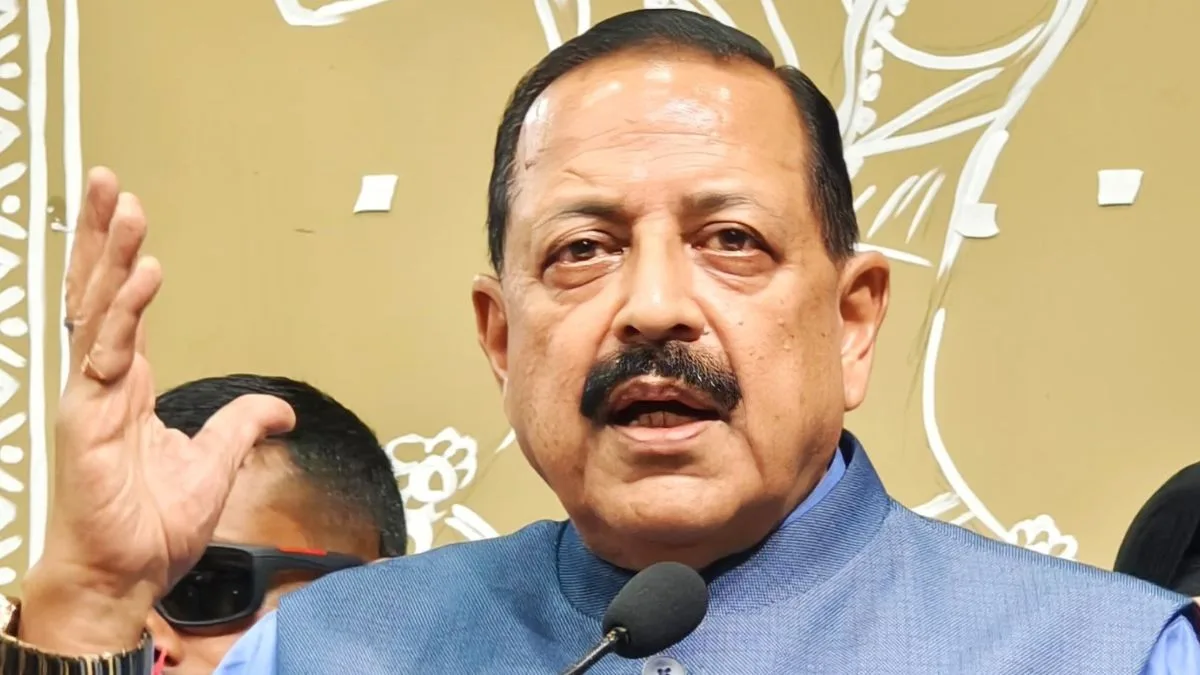
Union Minister of State (Independent Charge) for Science and Technology Dr. Jitendra Singh announced that Jammu & Kashmir will lead India towards its ambitious ‘Destination 2047’ vision during the launch of the ATL Sarthi Programme at the University of Kashmir.
Held on Thursday, the event marked a significant moment for the region, as Dr. Singh emphasized J&K’s prospective contributions to India’s economic growth. As India’s economy ascends from the fourth to the third position globally, he stated that regions like Jammu & Kashmir are poised to play a critical role.
“This region started receiving its due attention only after Prime Minister Narendra Modi took office in 2014,” Dr. Singh remarked. He pointed out the untapped vast resources of the Himalayas and rivers in J&K, which have become part of several initiatives launched by the current government, including the Aroma Mission.
Dr. Singh hailed the launch of ATL Sarthi as a “dual celebration” for transforming Kashmir University into a key player in India’s growth narrative. The Atal Innovation Mission aims to enhance innovation networks, thereby engaging this peripheral Union Territory in mainstream development.
Under the newly announced Frontier Region Programme, 500 Atal Tinkering Labs (ATLs) will open across Jammu & Kashmir, representing the largest share of 2,500 labs sanctioned for frontier regions. With an investment of ₹100 crore, these labs will expose students to advanced technologies such as robotics, 3D printing, and artificial intelligence from a young age.
Dr. Singh highlighted that India’s remarkable economic growth, driven by technology-led sectors such as space, biotechnology, and marine exploration, will bolster innovation in the coming years. “India’s space economy has rapidly grown from near zero to $8 billion, and it’s expected to reach $40–45 billion in the next decade,” he noted, citing a flourishing startup ecosystem that boasts over 400 active startups.
To sustain this growth trajectory, Dr. Singh stressed the need for public-private partnerships. “Without private player involvement, sustaining growth is challenging. Initiatives like InSpace in space research and BIRAC in biotechnology demonstrate how successful structured collaborations can be,” he stated.
Further expanding on Jammu & Kashmir’s emerging landscape, Dr. Singh pointed to the success of the Aroma Mission and the floriculture sector, which have resulted in thousands of new startups. Currently, around 3,500 lavender startups are flourishing in the region, prompting young people to return from corporate jobs to explore entrepreneurship.
Reflecting on the innovation potential, Dr. Singh shared that 50 students from J&K ranked among the top 1,000 in the nationwide School Innovation Marathon. He encouraged students and parents to dispel the notion that startups can only thrive in metropolitan cities, highlighting that nearly half of India’s startups originate from Tier 2 and Tier 3 cities.
“As we progress towards India@2047, the students in these tinkering labs will be in their prime working years. They will not just contribute to the nation’s growth but also position J&K as a torchbearer for this transformative journey,” Dr. Jitendra Singh concluded.
The launch event witnessed the presence of notable dignitaries, including Lieutenant Governor Manoj Sinha, Chief Minister Omar Abdullah, Education Minister Sakina Masood, and Vice-Chancellor of University Prof. Nilofer Khan, as well as AIM Mission Director Dr. Deepak Bagla.