


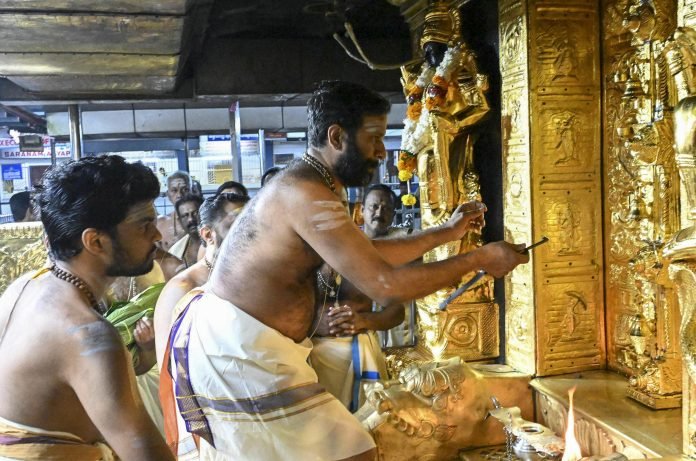
Hundreds of devotees thronged the famed Lord Ayyappa Temple at Sabarimala early on Monday, marking the auspicious first day of the Malayalam month ‘Vrischikam’ and the commencement of the annual Mandalam-Makaravilakku pilgrimage season.
Dressed in traditional black attire and carrying the sacred irumudikkettu, pilgrims from within Kerala and other states queued for hours to offer prayers. The temple portals opened by newly appointed melsanthi (chief priest) E.D. Prasad Namboothiri resounded with chants of Lord Ayyappa’s hymns echoing through the complex.
The opening occurred in the presence of tantri (head priest) Kantararu Mahesh Mohanaru, as confirmed by the Travancore Devaswom Board (TDB) in a statement. TDB officials noted a heavy flow of pilgrims even before dawn.
Devaswom Board Secretary P.N. Ganeswaran Potti, Sabarimala Executive Officer O.G. Biju, and other officials were also present during the ceremony. When the shrine opened at 3 a.m., long queues stretched across the nadapandal (covered walkway) and sopanam (holy steps).
Following the opening of the sanctum sanctorum, rituals including Nirmalya Abhishekam, Ganapathi Homam, and Neyyabhishekam were performed. The temple will close at 1 p.m., reopen at 3 p.m., and finally close at 11 p.m. with the chanting of “Harivarasanam,” the sacred lullaby of Lord Ayyappa.
The temple ceremonially opened on Sunday evening ahead of the two-month-long Mandalam-Makaravilakku season, which is expected to draw devotees from across the world. This iconic event annually attracts a multitude of faith-driven pilgrims.
The installation ceremony for the newly appointed melshanthis of the Sabarimala and Malikappuram temples also occurred on Sunday. To manage the expected rush, the TDB capped the daily number of pilgrims at 90,000—comprising 70,000 via the virtual queue system and 20,000 through spot booking.
The TDB’s planned regulations aim to ensure a smooth pilgrimage experience, preventing overcrowding while maintaining the sanctity of the rituals. As the sacred season progresses, safety measures, including crowd management and health protocols, remain vital.