


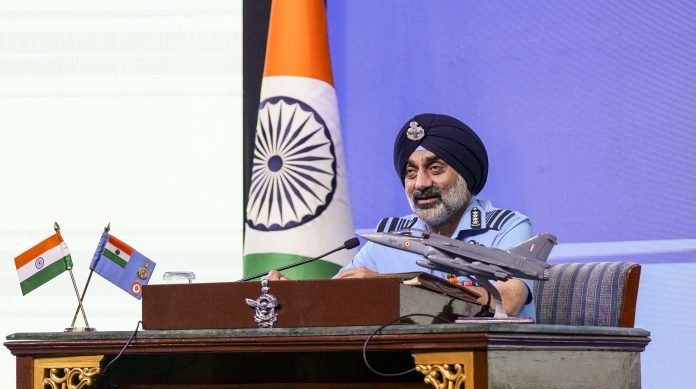
The Indian Air Force (IAF) achieved a remarkable success by reportedly destroying 4 to 5 Pakistani fighter jets, predominantly F-16s, during its recent Operation Sindoor. IAF Chief, Air Chief Marshal Amar Preet Singh, made this announcement on Friday in New Delhi, highlighting the operation’s significance in modern aerial combat.
Singh addressed the media, detailing the IAF’s precision strikes on multiple Pakistani airbases. This operation inflicted severe damage on critical military infrastructure, including radars, command centres, runways, and hangars. He added that the IAF even targeted a surface-to-air missile (SAM) system, with a C-130-class transport aircraft and potentially a high-value surveillance plane also suffering significant damage during the strikes.
“We struck a large number of their airfields and installations…radars at four places, command centres at two locations, two runways, and three hangars were destroyed. We have evidence of one C-130 aircraft being hit, and at least 4–5 fighters, most likely F-16s, which were under maintenance at that time,”
the Air Chief Marshal stated, underlining the scale and precision of the operation.
In an impressive display of technology and strategy, the IAF employed its newly acquired long-range SAMs that effectively barred the Pakistan Air Force from conducting any operations within its territory. This mission marked a historic achievement for the IAF, showcasing the longest successful missile strike of over 300 kilometres. This striking capability greatly compromised Pakistan’s ability to mount an aerial response.
Singh described Operation Sindoor as a decisive and time-bound success. He stated, “This was a war started with a clear objective and concluded swiftly once our goals were achieved. Unlike prolonged global conflicts, India demonstrated that clarity and precision can force an adversary to ask for a ceasefire.”
The operation not only highlights the operational proficiency of the IAF but also serves as a vital lesson for global military strategy in today’s geopolitical climate. Singh emphasized the need for sharing this experience with the world, especially considering the ongoing international conflicts that seem to lack resolution.
Experts believe such surgical strikes exemplify a shift in warfare dynamics in South Asia, with India showcasing its advanced military capabilities and strategic depth. The confidence shown in the IAF’s operational readiness could significantly alter regional security calculus.
Singh also reiterated the vital role of international partnerships and intelligence-sharing in contemporary warfare. The advancements in air striking capabilities could redefine engagement models, challenging conventional approaches to military confrontations.
As discussions about military preparedness continue within India and across the globe, the IAF’s successful execution of Operation Sindoor might pave the way for a new strategic paradigm, emphasizing the importance of technology-driven warfare solutions.