


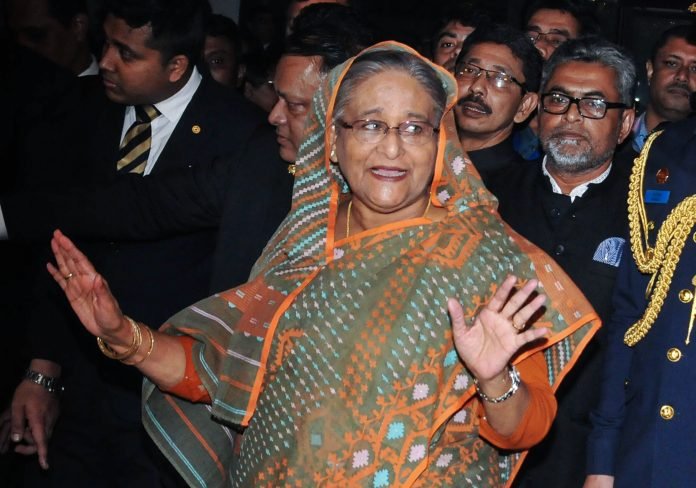
Ousted former Bangladesh Prime Minister Sheikh Hasina has declared that her return to Bangladesh depends on the restoration of participatory democracy and the lifting of the ban on the Awami League. She made these statements in an exclusive interview with PTI from an undisclosed location in India.
Hasina asserted that she would only consider returning after the current interim regime, led by unelected Prime Minister Dr. Muhammad Yunus, conducts free and fair elections. She criticized Yunus’ administration for damaging the vital relationship between India and Bangladesh and empowering extremist forces within the country.
In her interview, Hasina expressed deep gratitude to the Indian government and its people for providing her refuge during a tumultuous period. “I am immensely grateful to India’s government and its people for their kind hospitality,” she stated. She emphasized that the most critical condition for her return reflects the desires of the Bangladeshi people: a shift back to participatory democracy.
She has been clear about her prerequisites for returning to Bangladesh: the rescission of the ban on the Awami League and an inclusive electoral process. As the longest-serving leader in Bangladesh, Hasina departed her country on August 5, 2024, amidst violent protests that eventually led to her resignation.
When asked about the accusations of her government mishandling the protests, Hasina acknowledged the reality: “Obviously, we lost control of the situation and that was regrettable.” However, she attributed the crisis to “seasoned political firebrands masquerading as student leaders” who exacerbated tensions.
In response to rumors about her calling for a boycott of the upcoming elections scheduled for February 2025, Hasina refuted them decisively. She argued that any election conducted without the participation of the Awami League would lack legitimacy. “Tens of millions of people support us. It would be a huge missed opportunity for a country that badly needs a government with genuine consent of the people,” she asserted.
Hasina also launched a fierce critique of Yunus, accusing him of harboring hostility towards India, which she claims weakens the essential strategic partnership between the two nations. She described Yunus as “unelected, chaotic, and dependent on extremist forces,” warning that his diplomatic blunders could have dire consequences for Bangladesh-India relations.
Reassuring the Indian populace cautious about the current state of relations, Hasina remarked, “The interim government doesn’t represent what our people think. India is and will remain our nation’s most important friend.”
Moreover, Hasina expressed her willingness to face trial under international supervision, including at the International Criminal Court (ICC). She condemned Yunus for evading such scrutiny, claiming that an impartial tribunal would likely exonerate her. She dismissed the Bangladesh International Crimes Tribunal, which is pursuing the death penalty against her, labeling it a “kangaroo tribunal” designed to politically neutralize her and the Awami League.
“They want to eliminate us as political forces. The fact that they would use the death penalty to silence opponents shows how little respect they have for democracy or due process,” Hasina stated emphatically. She also pointed out how Yunus previously enjoyed passive support from some Western liberals, a backing that is diminishing as they witness his alignment with radical elements and discrimination against minorities in Bangladesh.