


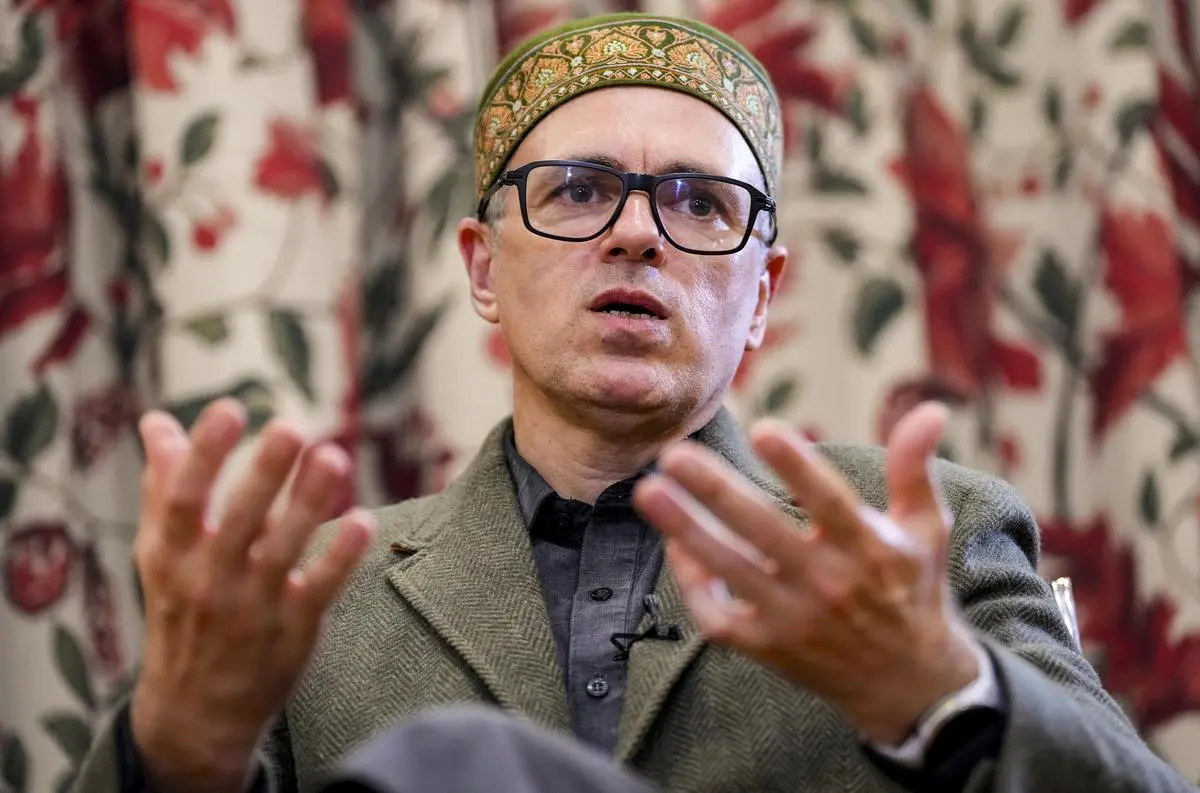
Jammu and Kashmir Chief Minister Omar Abdullah emphasized that Tamil Nadu Governor Rajendra Vishwanath Arlekar should allow Tamilaga Vettri Kazhagam (TVK) leader Vijay an opportunity to prove his majority in the assembly. Abdullah made this statement during a press conference held on Friday.
On Thursday, the Tamil Nadu governor rejected Vijay’s claim to form the government, asserting that the party lacks the requisite numbers. Currently, TVK has fallen short of securing a simple majority, essential for government formation in the 234-member Assembly.
Although the Congress party, with five MLAs, has extended its support to TVK, it still does not reach the required threshold of 118 seats. This political situation has sparked significant discussions about the implications of inviting the single largest party to form the government.
Abdullah criticized the imposition of President’s rule in Tamil Nadu. He highlighted the relevance of recent Supreme Court (SC) judgments, which consistently emphasize the need for inviting the largest party post-elections to prove its majority on the assembly floor.
“If we consider the Supreme Court judgment, there should be no President’s rule,” Abdullah declared. “The SC has clarified in numerous cases that the single largest party should be invited for government formation and be allowed to demonstrate its majority.”
In his remarks, Abdullah referred to past instances, including former Prime Minister A.B. Vajpayee’s 13-day government formation in 1996, where the President permitted him to attempt governance despite lacking immediate numbers. “The President did not delay the invitation for him to prove his numbers,” he stated. “Vajpayee had to resign when he failed to secure the requisite support.”
According to Abdullah, the current political framework in Tamil Nadu does not justify limiting TVK’s opportunity. He urged that Vijay must be given the chance to form a government and subsequently demonstrate his majority. “If he proves his majority, he will continue; if not, he must resign,” Abdullah concluded. This insight reflects an ongoing debate on the norms of governance and political stability in the state.